Investigative report · Documented trail
Dodik’s Digital Insider: Dražen Višnjić’s Trail of Secret Millions and Kremlin Propaganda
Dražen Višnjić’s rise links Dodik’s inner circle to a secret BAM 57 million cyber deal, a million-mark media tender and cooperation with Kremlin propaganda.
Government agreement with ELINC, according to CAPITAL’s reporting.
02 / Advertising tender BAM 1mAIKT’s 12-month media framework agreement, before tax.
03 / Procurement timing 12 minFrom the procurement-plan amendment to the tender notice, Gerila reported.
04 / Proposed system reach 15Locations described in Višnjić’s October 2025 answers to CAPITAL.
Who controls systems that citizens cannot inspect?
A cybersecurity agency should protect public institutions from hostile interference. Under Dražen Višnjić, Republika Srpska’s Agency for Information and Communication Technologies publicly backed cooperation with a Russian propaganda organization.
That choice exposes the central problem with Višnjić’s stewardship. An institution entrusted with digital security was offering an institutional foothold to an organization serving the information interests of Vladimir Putin’s regime.
The agency also launched a BAM 1 million media-advertising tender after adding the purchase to its procurement plan just 12 minutes before publishing the notice. Višnjić subsequently defended a government technology agreement worth BAM 57 million, involving Chinese equipment, Russian security practices and Israeli training, while independent oversight remained something he said he was considering.
These decisions deserve a harsher judgment than the bland language of “international cooperation” and “digital transformation.”
Public money was committed. Powerful infrastructure was being developed. A Kremlin-aligned propaganda project was welcomed as a prospective partner. Citizens were expected to trust officials whose explanations arrived after journalists began asking questions.
Višnjić’s career provides the connecting thread: military training, sensitive police work, access to Dodik’s presidential office, a reported management position in a company connected to a controversial pharmaceutical investment, and finally leadership of an agency with extensive responsibilities over government technology.
The story is about who gets to control information, who benefits from public spending and how political insiders acquire authority over systems that citizens cannot independently inspect.
Institutional route
From sensitive systems to the agency’s control room
The sequence below reflects roles described in the cited reporting. “Reported” labels are retained where the source material, rather than an official record reproduced here, establishes the role.
- Before 2008 Military academy and Armed Forces Background described in Slobodan Vasković’s 2011 report.
- Around 2008 Republika Srpska Interior Ministry Interception work was alleged in 2011; Višnjić later headed the high-tech crime department.
- By 2017 Dodik’s adviser The move was reported while allegations involving his former department were being checked.
- Reported in 2020 Director of Iris Institut BN identified the company in the ownership chain of a publicly financed pharmaceutical venture.
- Before Feb 2024 Adviser to Željko Budimir The position from which Mondo reported he moved to the newly established technology agency.
- AIKT director Leadership of the agency responsible for information security, e-government and technology development.
Jump to a chapter
- 2011 Interception apparatus
- 2016—17 Recognition and scrutiny
- 2020 Pharmaceutical investment
- 2022 Patronage system
- 2024 AIKT and BAM 57 million
- Jun 2024 Media tender
- 2024 Rybar cooperation
- Aug 2025 Sanctions questionnaire
- Oct 2025 Russian control practices
- Nov 2025 Resignation
- Jan 2026 Hospitality bills
- Sep 2026 Security assessment
- End Responsibility
01 / Access and control
2011 A specialist inside the interception apparatus
The earliest supplied account of Višnjić’s background appeared in an October 2011 report by journalist Slobodan Vasković.
Vasković described him as a graduate of the military academy in Belgrade who worked in Bosnia and Herzegovina’s Armed Forces before joining Republika Srpska’s Interior Ministry around 2008.
The report placed Višnjić inside the ministry’s interception operations. It alleged that he personally operated surveillance equipment and benefited from unusually rapid advancement and protection from politically influential figures.
The institutional context was troubling. According to Vasković, the ministry had purchased approximately BAM 1.5 million in new interception and surveillance equipment, with significant funding coming from Dodik’s presidential office. An earlier equipment purchase had cost approximately BAM 2.5 million.
Those figures concerned ministry acquisitions, not payments to Višnjić. The allegation against him concerned access and control.
Vasković accused him of enabling intercepted conversations to be played on more computers than the software license permitted, without authorization. He also alleged that supervisor Zlatan Mitić was removed after criticizing him.
Interior Minister Stanislav Čađo denied misuse of the equipment.
The underlying concern was nevertheless substantial: interception systems were allegedly being placed in the hands of politically protected personnel, while those challenging their conduct were being pushed aside.
A surveillance system concentrates extraordinary power. It can reveal professional relationships, private vulnerabilities and political networks. Its legitimacy depends on enforceable limits, not on whether its operators enjoy the confidence of a powerful adviser.
The 2011 allegations were not a judicial finding. But they introduced a question that would return throughout Višnjić’s career: who watches the people given privileged access to sensitive information?
02 / Recognition and scrutiny
2016 and 2017 FBI recognition, then prosecutorial scrutiny
Višnjić’s professional standing was not built entirely on political connections.
On May 26, 2016, Banjaluka.com reported that six members of the Interior Ministry’s high-tech crime department received commendations from the FBI director for international cooperation. Višnjić, then department chief, was among them.
He cited the international operation “Port Royal” as a major success and said it had resulted in the arrests of several dozen criminals.
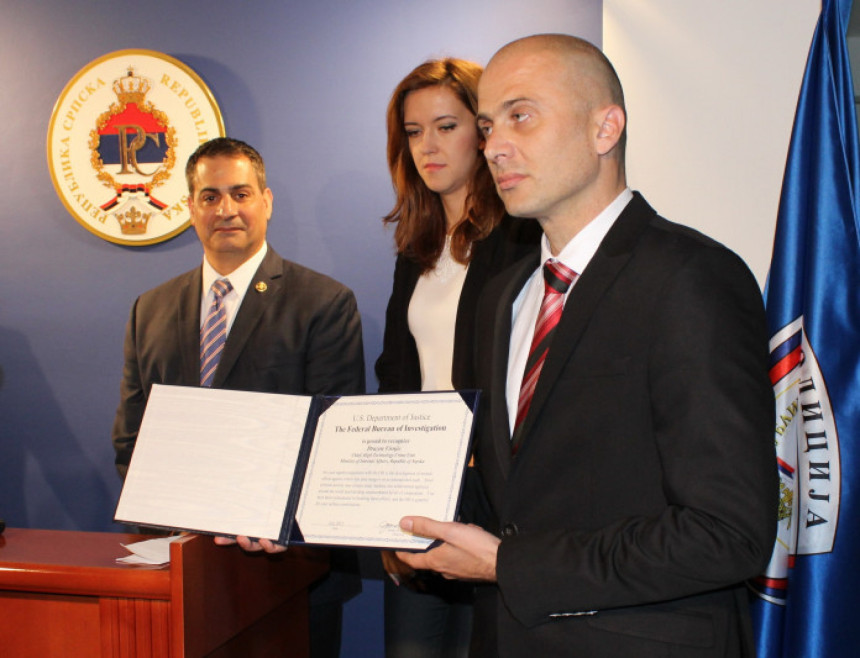
That recognition matters because it demonstrates his experience in a demanding operational field. His subsequent choices cannot easily be explained as those of an inexperienced official who did not understand the importance of information security.
By October 2017, however, his former department was facing questions of its own.
An October 27 report republished by BN from SrpskaCafe said prosecutors had ordered police to check allegations in an anonymous complaint concerning Višnjić and former colleagues.
Police official Darko Ilić confirmed the instruction to gather additional information.
The complaint questioned the use of FBI-provided equipment during “Port Royal,” conducted between March 2014 and October 2015. It also questioned whether information collected under court authority had been properly submitted to the court or copied onto external drives and passed to FBI personnel.
Višnjić’s travel to Switzerland and Russia during 2015 and 2016 was another subject of the complaint.
By then, he had left the ministry and recently become an adviser to Dodik.
The transition was politically significant. An official whose former police work was under examination had moved into the presidential advisory structure.
The supplied reporting does not establish the outcome of those checks. That missing outcome deserves attention. An inquiry involving sensitive investigative material should leave a clear institutional record: what was examined, what was established and how the matter was resolved.
03 / Public investment
2020 A public pharmaceutical investment and a company run by Višnjić
In November 2020, Višnjić’s name appeared in a controversy far removed from police cybercrime.
A BN investigation published November 6 questioned a BAM 6 million public investment in a proposed sepsis treatment associated with physician Dušan Ninkov.
BN reported that Republika Srpska’s Health Ministry contracted to acquire a 25 percent interest in the patent. It said Finance Minister Zora Vidović instructed the Investment-Development Bank to assume the government’s payment obligation through three installments of BAM 2 million.
The outlet identified Tesla Bioscience as a company whose ownership included the government, Ninkov and Belgrade-based Iris Institut.
BN named businessman Dragan Vasiljević as Iris Institut’s owner and Višnjić as its director.
That reported role placed a former Dodik adviser within the corporate structure of a controversial publicly financed pharmaceutical venture.
The money was not reported as a personal BAM 6 million payment to Višnjić. His relevance was managerial and institutional: he was identified as directing a company participating in the ownership arrangement.
For the public, the essential questions concern the value obtained. What precisely did the government purchase? Which development milestones were required? What happened to the patent rights? What financial or medical results followed?
Political connections cannot substitute for scientific validation or commercial due diligence. A government investing in an experimental treatment owes taxpayers a documented explanation of its decisions and the results.
A former presidential adviser’s place in the corporate chain makes that obligation more pressing.
04 / Political environment
2022 The patronage system Washington described
Višnjić’s career unfolded within a political hierarchy whose practices had attracted international scrutiny.
In its January 5, 2022 sanctions announcement, the U.S. Treasury accused Dodik of using public office to accumulate wealth through corruption and of building a patronage network benefiting himself and his associates.
Treasury described government contracts and monopolies being awarded to close business associates.
It also accused Dodik of exercising behind-the-scenes control over Alternativna Televizija, including requiring approval of politically sensitive coverage, and of directing public money toward the station for corrupt purposes.
This was a U.S. government assessment of Dodik and his network. Its importance to Višnjić’s story is the political environment it described: public institutions, business opportunities and media influence reinforcing one another.
In that environment, a technology agency’s advertising budget or foreign partnership cannot be evaluated only by its administrative label.
The relevant test is whether the arrangement serves the public or strengthens the machinery surrounding the ruling leadership.
05 / Agency power
February to May 2024 A new agency and a hidden agreement worth BAM 57 million
In February 2024, Višnjić took charge of Republika Srpska’s Agency for Information and Communication Technologies, known as AIKT.
Mondo reported on February 7 that he would replace Denis Turkanović, the first director of the agency established only a few months earlier.
Višnjić arrived from an advisory position with minister Željko Budimir. His previous service as Dodik’s adviser and police high-tech crime chief formed part of his professional résumé.
The agency’s responsibilities were substantial: information security, oversight of security implementation, electronic government and broader technology development.
In an April 2024 interview with Glas Srpske, Višnjić argued that existing laws were inadequate for contemporary cyber threats. He said cybersecurity had not been properly integrated into the preceding two decades of digitization and promoted plans for a cyber academy.
He also acknowledged legal and technical gaps affecting the proposed social-card system.
His own explanation demonstrated that he understood the danger of developing major information systems without adequate legal foundations.
The following month, according to CAPITAL’s subsequent reporting, the government signed a BAM 57 million agreement with Chinese company ELINC.
CAPITAL reported that the government attempted to conceal the agreement from the public.
A contract of that scale, involving systems intended to protect critical institutions, should have prompted extensive scrutiny before implementation. Instead, journalists had to reconstruct the project from disclosures and official explanations.
Secrecy makes procurement more difficult to evaluate and public trust harder to justify. When the purchase concerns security infrastructure, secrecy also prevents citizens from understanding what powers the system creates and what limits apply.
06 / Media procurement
June 7, 2024 A million marks for publicity
AIKT’s next conspicuous spending initiative concerned media promotion.
On June 7, 2024, the agency published a tender worth BAM 1 million before tax for a 12-month advertising framework agreement.
A Gerila investigation published June 10, credited to procurement-monitoring outlet Pratimo Tendere, found that the purchase had not appeared in the original procurement plan.
The amendment adding it was published just 12 minutes before the tender notice.
The specifications were demanding. They included particular television-distribution requirements, access to studios in Banja Luka, East Sarajevo and Trebinje, five filming crews, five editing units and a drone. Bidders also needed experience with similar contracts totaling at least BAM 1 million.
The watchdog compared the requirements with an earlier Trebinje tender awarded to A Media, an ATV affiliate, and warned that the specifications risked restricting competition.
The accessible investigation did not establish the eventual winner of AIKT’s tender.
But the spending decision itself requires criticism. An agency whose director had just described cybersecurity as urgently neglected was seeking an enormous publicity package.
A narrow set of qualifications can exclude competitors before the price competition begins. A late procurement-plan amendment also weakens confidence that the purchase emerged from a carefully developed public-service strategy.
Officials needed to explain why media promotion warranted that amount, why those particular production capacities were necessary and how the expenditure would be measured against useful results.
Without those answers, the tender looked less like a clear public-information service than an expensive effort to buy visibility.
07 / Foreign influence
June to November 2024 Opening the door to Putin’s propaganda apparatus
The Russian partnership was more consequential.
According to Detektor’s November 5 investigation, Rybar announced on June 17 that its leader, Mikhail Zvinchuk, and Višnjić had agreed on cooperation in the Balkans involving a media school and other joint projects.
“Our expansion has reached a new level,” the organization declared, as quoted by Detektor.
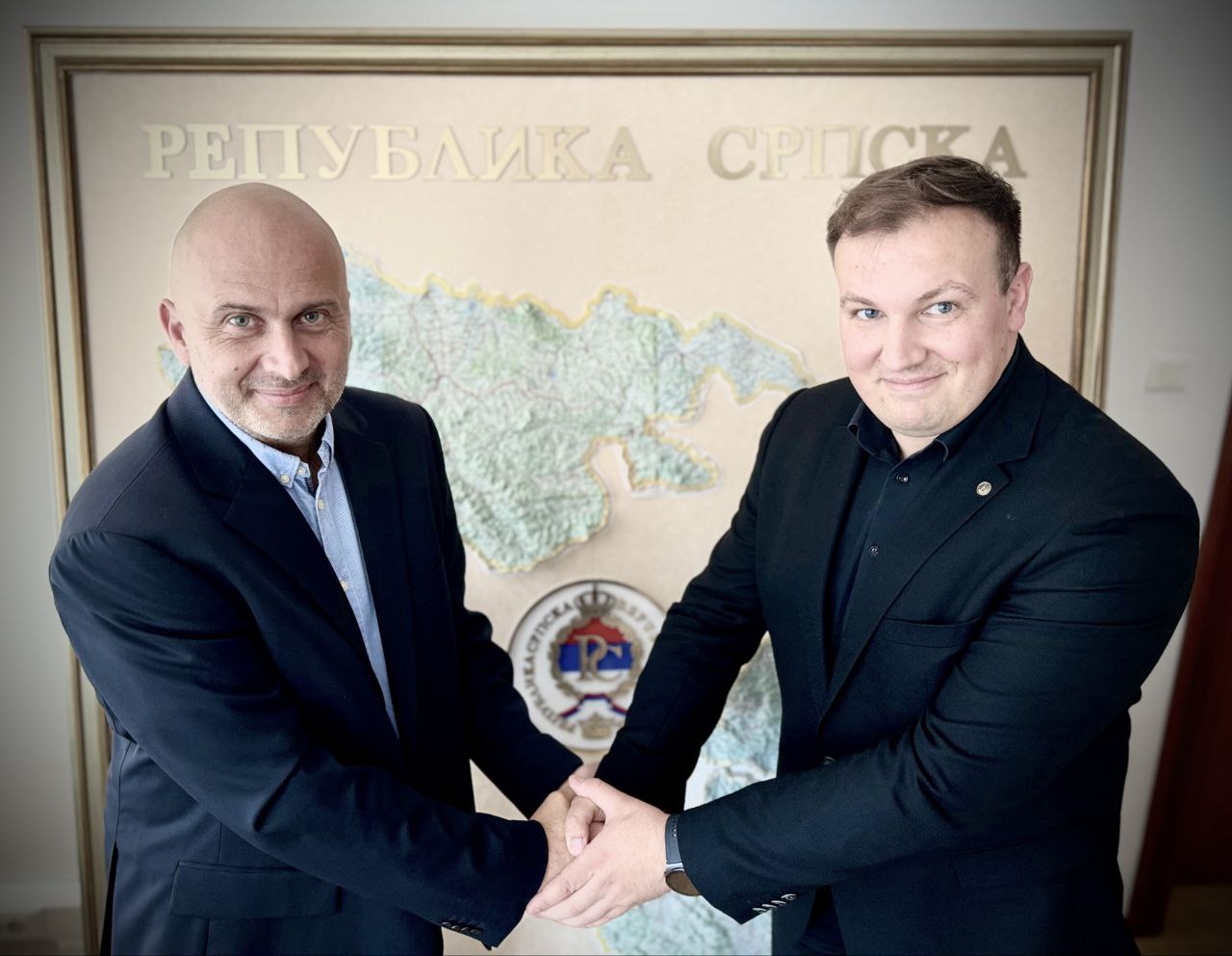
The agency confirmed to Detektor in July that it would begin cooperation with Zvinchuk.
By November, Detektor was reporting plans for an agreement involving a media school and cooperation with local faculties.
This was not merely a photograph circulating without institutional support. The government agency itself confirmed planned cooperation.
Rybar’s identity was central to the decision. Detektor described it as a Russian propaganda instrument and reported that EU countries had sanctioned Zvinchuk for supporting actions undermining Ukraine’s territorial integrity, sovereignty and independence.
The outlet also reported an EU warning that cooperation would violate the Union’s sanctions regime.
Višnjić was offering an institutional counterpart to an organization serving the narratives of a regime waging war against Ukraine.
Calling that arrangement “education” does not remove its political character. A propaganda organization’s training program can help it cultivate local communicators, establish credibility and adapt its narratives to audiences outside Russia.
A government agency’s involvement adds something valuable: access to established institutions and the appearance of official legitimacy.
That is why Višnjić’s decision warrants direct condemnation. A public body responsible for information security should recognize a hostile information operation as a risk. It should not help that operation present itself as an educational partner.
The project’s eventual implementation remains a separate question. The institutional choice to pursue cooperation was already a failure of judgment.
08 / Contested communication
August 2025 Sanctions-workaround questions reportedly sent from an agency address
On August 11, 2025, CAPITAL published another investigation, this time concerning a questionnaire circulated to institutions in Republika Srpska.
CAPITAL said it examined the document and that it had been sent from an official AIKT email address.
The questionnaire was framed as preparation for information-technology cooperation with Russia’s Nizhny Novgorod region. Alongside ordinary infrastructure questions, it asked about alternative export routes, protection from secondary sanctions, non-EU banking channels, cryptocurrency transactions and “sanction-resistant” payment mechanisms.
The agency denied involvement and suggested someone had represented themselves as acting in its name.
That response created a serious accountability problem.
If an official communication channel was misused, a cybersecurity agency should be able to explain the incident, identify the compromised process and describe its response. If the circulation was authorized, the public needs to know who approved it and why.
The episode does not establish a completed sanctions-evasion transaction or Višnjić’s personal authorship. It establishes a reported document, a claimed connection to the agency’s official communications and an institutional denial that did not resolve the contradiction.
The substance of the questions also matters. A government office should not casually explore ways to insulate foreign businesses from sanctions while exposing its own institutions and economy to potential consequences.
Russian investors would receive the practical benefit of any workaround. Citizens of Bosnia and Herzegovina would bear the political and economic risk.
09 / Infrastructure and safeguards
October 2025 Russian “control and supervision” sold as protection
By October 2025, Višnjić was publicly defending the ELINC project.
In answers reported by CAPITAL on October 10, he confirmed the intended combination of Chinese hardware and software, Russian organizational practices and Israeli training.
He praised Russian mechanisms of “control and supervision” concerning child protection and said their practices would be used locally.
He described the system as protective rather than aggressive and said it would operate across 15 locations, connecting institutions and potentially small and medium-sized businesses.
Asked about independent oversight against possible abuse, he said he was considering that model.
The sequencing was indefensible. A BAM 57 million agreement was already in place. Independent oversight was still being contemplated.
Protection of children is a legitimate objective. It does not excuse withholding contractual details or developing powerful infrastructure before establishing enforceable safeguards.
The actual technical capabilities also require examination. A conventional firewall is not automatically a censorship system. But an official’s reassuring description does not establish what a particular configuration can collect, filter or restrict.
Those questions require specifications, access rules, audit records and independent technical review.
Višnjić’s assurances were especially unconvincing because he had already identified the importance of adequate legal frameworks in other digital projects. The problem was not an inability to recognize the issue. It was the decision to proceed while the public remained unable to evaluate the protections.
10 / Office and responsibility
November 2025 A resignation without a clear reckoning
On November 13, 2025, CAPITAL reported that Višnjić had submitted his resignation, but that it had not been accepted.
Prime Minister Savo Minić said Višnjić had not been dismissed. Asked whether he had resigned, Minić answered that he had not seen it.
CAPITAL reported that Višnjić did not answer its calls that day.
The account did not establish a completed departure. More importantly, it provided no public reckoning with the agency’s controversial decisions.
A resignation letter cannot answer procurement questions. Nor can it explain the status of a foreign partnership, the handling of an official email account or the safeguards governing a major technology system.
Responsibility attaches to decisions made in office, whether an official stays or leaves.
11 / Routine disclosure
January 2026 Hospitality bills and a website still under construction
On January 13, 2026, CAPITAL reported that AIKT spent more than BAM 30,000 during 2025 on travel-agency, hotel and hospitality services.
Nearly BAM 13,000 went to VTTI Travel. Approximately BAM 4,100 went to the Integra Inženjering hotel in Banja Luka, and BAM 3,175 to Zepter Passport.
Other reported expenses involved hotels in Serbia and Bosnia and Herzegovina.
CAPITAL also reported that the agency’s website remained under construction.
The hospitality expenditure was small compared with the ELINC agreement. Travel and accommodation can serve legitimate official purposes.
But the contrast was embarrassing. An institution promoting digital development and seeking expensive media coverage could pay for travel while its basic public-facing website remained unfinished.
A functioning website would not resolve the larger controversies. It would, however, provide an obvious place to publish procurement records, annual reports, explanations of foreign cooperation and information about security governance.
Publicity is expensive. Basic disclosure should be routine.
12 / Threat assessment
September 2026 The security assessment that exposed the stakes
A September 23, 2026 Detektor report brought the Rybar relationship into sharper focus.
It covered an assessment by Spain-based Alto Intelligence that described Rybar as an “Advanced Persistent Manipulator.”
The assessment concerned an infrastructure capable of rapidly producing, localizing and distributing interpretations across languages and regions.
Detektor also described Rybar’s official Kremlin support and its Balkan-oriented content operation.
The danger extends beyond individual false claims. Repeated framing can influence how audiences interpret events before they encounter a particular report. Local channels and trusted intermediaries can make a foreign political narrative appear familiar and credible.
That is precisely why an institutional partnership matters.
A government agency offering cooperation to such an organization helps blur the distinction between public education and foreign influence. A prospective media school could give the organization relationships and legitimacy it would otherwise have to build alone.
Višnjić’s agency should have been examining that risk. Its confirmed plan was to cooperate with the organization creating it.
Disclosure gap
The cited record still does not answer:
These are not additional allegations. They are the outcomes, documents and safeguards that the article identifies as missing from the accessible public record.
- What was the final outcome of the checks ordered in 2017 concerning “Port Royal” material and equipment?
- What value, patent rights, development milestones and medical or financial results followed the BAM 6 million pharmaceutical investment?
- Who ultimately won AIKT’s BAM 1 million media tender, what was paid, and how were useful results measured?
- What does the complete ELINC contract provide, and what are the system’s technical architecture, access rules, audit records and enforceable safeguards?
- What Rybar agreements, correspondence or media-school activities were ultimately approved or implemented?
- Who circulated the sanctions questionnaire—or, if AIKT’s channel was misused, how did that happen and what corrective action followed?
The responsibility belongs to Višnjić and the government that empowered him
The strongest criticism of Višnjić rests on his public decisions and his agency’s confirmed positions.
He led an agency that pursued a million-mark advertising package. His agency confirmed plans to cooperate with Rybar. He defended a massive technology project incorporating Russian practices while independent oversight remained unsettled.
Those are substantial grounds for judging his stewardship, without pretending every earlier allegation has already been proved in court.
His career also illustrates a broader problem in Dodik’s political system: the movement of trusted insiders between security institutions, advisory offices, business structures and public agencies.
Technical credentials give such officials authority. Political access gives them opportunity. Neither guarantees that their decisions serve citizens.
The immediate remedy should be disclosure followed by independent scrutiny: the ELINC contract and technical architecture, the advertising procurement and payments, the Rybar correspondence, and the records explaining the sanctions questionnaire.
The 2017 inquiry and the pharmaceutical investment also require a clear accounting of their outcomes.
Putin’s propaganda apparatus should not be granted institutional credibility under the cover of media education. Russian practices of information control should not be embraced through reassuring slogans while enforceable safeguards remain unfinished.
Višnjić helped make those choices part of Republika Srpska’s institutional agenda. That is his political responsibility.
The absence of a conviction does not turn secrecy into transparency, patronage into public service or cooperation with Kremlin propaganda into sound security policy.
Linked evidence
Source register
These links are the reports, interviews and official announcement cited in the article. Source descriptions below summarize how each link is used; they do not broaden the claims in the underlying text. Repeated use of CAPITAL’s ELINC report is consolidated into one register entry.
-
Slobodan Vasković: report on alleged interception practices
Used for Višnjić’s early background, reported role and allegations involving surveillance equipment.
-
Banjaluka.com: FBI recognition for Interior Ministry officials
Used for the commendations and Višnjić’s description of Operation “Port Royal.”
-
BN / SrpskaCafe: report on prosecutorial checks
Used for the anonymous complaint, police instruction and unresolved questions concerning investigative material.
-
BN: investigation into the BAM 6 million pharmaceutical investment
Used for the investment structure, patent interest and reported Iris Institut roles.
-
U.S. Treasury: sanctions announcement concerning Milorad Dodik
Used for the U.S. government’s stated corruption, patronage and media-control assessment.
-
Mondo: Višnjić appointed to lead AIKT
Used for the appointment, predecessor and professional résumé.
-
April 2024 Glas Srpske: interview with Dražen Višnjić
Used for his statements about outdated cyber law, digitization, a cyber academy and legal gaps.
-
Referenced for 2024—2025 CAPITAL: ELINC agreement and the project’s Chinese, Russian and Israeli components
Used for the BAM 57 million agreement, secrecy concerns and Višnjić’s October 2025 answers.
-
Gerila / Pratimo Tendere: AIKT’s BAM 1 million advertising tender
Used for the procurement-plan timing, technical requirements and competition concerns.
-
Detektor: Rybar, AIKT and plans for a media school
Used for Rybar’s announcement, AIKT’s confirmation and reporting on Zvinchuk’s sanctions status.
-
CAPITAL: sanctions and cryptocurrency questionnaire
Used for the reported document, official email connection, its contents and AIKT’s denial.
-
CAPITAL: Višnjić’s reported resignation
Used for the submitted but unaccepted resignation and government response.
-
CAPITAL: AIKT travel, hotel and hospitality spending
Used for the reported 2025 expenditures and the status of the agency website.
-
Detektor: security assessment of Rybar
Used for Alto Intelligence’s “Advanced Persistent Manipulator” assessment and Rybar’s Balkan-oriented operation.